
Made in Germany
 Why the Paleos® cannot be "cheap"!
Why are series ULTRA and CLASSIC much more expensive than conventional shoes or other minimal footwear? Well, let us tell you about the product development and production of our fantastic chainmail products. This may help you understand how valuable the PaleoBarefoots® are, how much manual labour is involved in their production as well as how much longer they will last than other "shoes" in daily use. This is especially true for the product lines PaleosULTRA and CLASSIC which entirely consist of chainmail.
It began with the simple idea to produce barefoot minimal shoes from chain mail. Chain mail has been used for centuries for protection. You probably immediately think of knights and soldiers but now chain mail is being used by butchers, fishmongers, textile and steel workers, who use chain mail gloves to protect their hands from cuts when using sharp knives, scissors and other sharp machinery. It was when we decided to apply this ring mesh to a minimal shoe that the PaleoBarefoots® was born.
The mesh is virtually indestructible! In the meat, fish and sheet metal industry such protective gloves are subjected to high stress treatment every day and for long hours. Gloves of this kind are used in industry to protect from hooks, sharp points, blades, cleavers, etc. Today we know that it can take years to wear down a pair of PaleoBarefoots®ULTRA or CLASSIC on natural substrates or in aquatic environment.
Technical parameters of our chain mail
- Stainless steel Continental European code: 1.4404
- (USA: 316L/Britain: 316S 11)
- 4mm chain mail: ring diameter outside: 4.0 mm
- Ring inner diameter: 2.9 mm
- Wire diameter: 0.55 mm + / - 0.01
- Weight per sq. yd: 6 lbs
- Rings per sq. yd: about 134,700 pieces
- Thickness of the mesh 1.4 mm
It takes around 134,700 individual rings to produce square yard of stainless steel wire mesh. Each ring intertwines with four others and is individually welded one by one. The result is a completely smooth ring mesh, each ring free to move independently of the others. The cost of high-quality stainless-steel alloy used, which requires sophisticated technology, is around US $700 per square yard - and that's before we even start making the Paleos®!
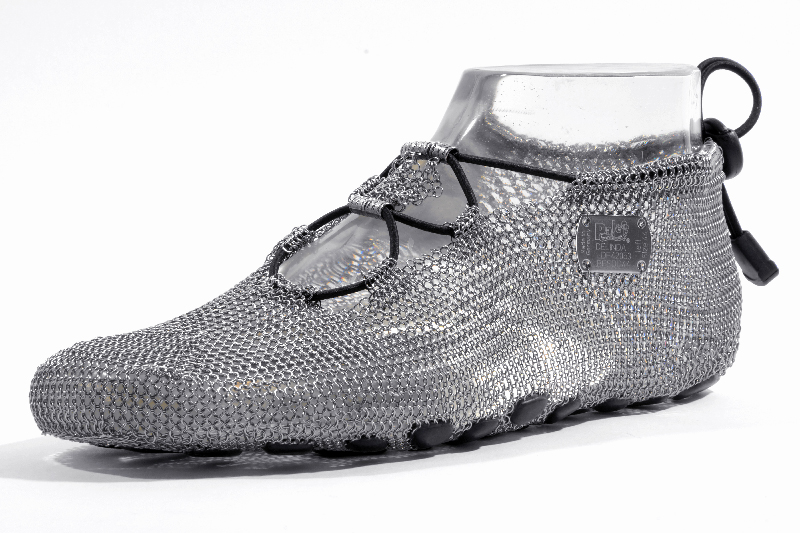
Thickness of the chain mail mesh (e.g. soles of PaleoBarefoots®), since the material does not form a flat surface and the individual rings are angled against one another, the "thickness" of the sole varies in measurement from 1.1 mm to 1.6 mm, thus, the average thickness of the mesh is approximately 1.4 mm.
Since the material structure is completely open, the thickness of the material on soft ground such as sand, earth, moss, etc. 0 mm can be felt!
Paleos®ULTRA and Paleos®CLASSIC
- In the process of coming up with our final designs for PaleoBarefoots® we went through many prototypes of differing models, cuts, material bias running in different directions, etc - each piece was created by hand and painstakingly assembled. We began the process using artificial foot models; later, we fitted them to living human feet. It took months of work to achieve a satisfactory result, and even then, the shoe required a variety of post-manufacture adaptations.
- Once a prototype was ready for production, it was broken down into its components (again, a manual process) and each piece was catalogued and programmed for individual production. This allows the production of each component to be automated on an industrial level later.
- During assembly, the loose components of ULTRA or CLASSIC are then carefully manually intertwined and fused, ring by ring. If everything has worked correctly, both the automated and manually produced shoe are exact duplicates of each other. The machine-made PaleoBarefoots® corresponds exactly to the original prototype.
- After welding, the individual rings in the steel mesh are no longer shiny but are dull and matt from the intense heat used. The next step is a process of multiple cleaning baths to polish and restore the impressive beauty and shine to the stainless-steel mesh.
- At this point, you might think that our PaleoBarefoots® would be ready for production. Not yet! Up to now there's only been one size and a single shape! Special foot models now had to be "invented" to simulate cuts and bias and to determine what the material’s behaviour might be for other sizes. Since a change of foot dimensions directly affects the behaviour and the length of the material, this step was a major challenge.
- Ultimately, other components such as lacing, spacers, locking systems, push buttons and so on are assembled. At the end of the process, each PaleoBarefoots® gets an individualised laser cut metal plate containing serial number, the PaleoBarefoots® model name and the size. Only now the shoe is ready for sale!
Perhaps now you can better understand why the seemingly high price of the PaleoBarefoots® is quite reasonable, considering the high-tech machinery as well as the manual labour involved. Also the ultimate longevity of the material the finished product price is very favourable, never mind their extraordinary therapeutic effects!
Check e.g. Amazon how much you are asked to pay for just a SINGLE stainless-steel chain mesh glove.
Important note! PaleoBarefoots® are entirely "Made in Germany". German manufacture is one more reason why it is not easy to wear them down on natural soils, either on land and in the water. Properly used and well maintained a pair of Paleos®ULTRA or CLASSIC can last for years!
 Link to the natural world and enjoy the safest barefoot feel with the #paleos #chainmailshoes by GoSt-Barefoots!